Volunteer Firefighter Lights: What's Legal on Your POV
 By
·
8 minute read
By
·
8 minute read
Volunteer firefighter lights are legal on a personal vehicle (a POV) in most states, once your chief or the state signs off. We checked the law in all 50 states: 41 let a volunteer add warning lights to their own car or truck. Most make them red. Eleven use blue, including New York, New Jersey and Pennsylvania, and Washington uses green.
What the lights let you do matters more than their color. In 17 states an authorized, lit POV counts as an emergency vehicle while you respond. In 19 others the lights are a courtesy: they ask drivers to yield, but you still stop at red lights and drive the speed limit. Six states do not let members respond with lights at all.
Courtesy light or emergency vehicle: what your lights let you do
State law puts a volunteer's lit POV in one of two groups, and the group decides whether you can speed, go through a red light or run a siren.
Courtesy light
The light identifies you as a responder and asks other drivers to give way. You get no exemptions: you stop at every red light and stay under the speed limit. Indiana's law says a driver showing a blue light "shall obey all traffic rules."
19 states, including New York, Pennsylvania, New Jersey, Illinois and Florida.
Emergency vehicle
While you respond with the lights on, and in most of these states the siren too, you may slow and proceed through a red light or stop sign and exceed the speed limit, with due regard for everyone else on the road.
17 states, including Texas, Georgia, Ohio, Michigan and Wisconsin.
Can volunteer firefighters speed? Only in the emergency-vehicle states, only while responding (never on the way home), and only with the required lights and siren running. Alaska, Iowa and North Dakota fall in between: they allow some speed but no right to go through a red light. In Arkansas, Mississippi and Missouri the statutes conflict or are silent, and the table says what each one does say.
Volunteer firefighter light laws in all 50 states
Find your state below. "Who signs off" is the authorization the law names, and your department can add its own rules on top. Each row links the statute or state rule it comes from.
| State | Lights on your POV | Who signs off | Siren | Speed and red-light privileges | The law |
|---|---|---|---|---|---|
| Alabama | Not while driving. State police allow them only when parked at a scene | Not available: the state designates only publicly owned vehicles | No | No | ALEA volunteer guidance Code of Ala. §32-5A-115 |
| Alaska | Blue | Chief's OK plus written authorization from the Commissioner of Public Safety, valid 5 years | No | Partly: may exceed the speed limit with care, but must stop at stop signs and red lights | 13 AAC 04.100 13 AAC 02.517 |
| Arizona | Not allowed | Not available | No | No | A.R.S. §28-947 |
| Arkansas | Red (portable dash lights allowed) | None named | Unclear since a 2017 rewrite of the code | Unclear since the same 2017 rewrite | Ark. Code §27-51-905 §27-36-304 |
| California | Not for members. The chief, assistant chief and one designee can get a CHP permit for red | California Highway Patrol permit | Only with the CHP permit | Only with the CHP permit | Cal. Veh. Code §2416 |
| Colorado | Red (white allowed) | Chief's permit; a DMV "red dot" designation for full emergency status | Yes | Yes with the DMV designation; unclear with the chief's permit alone | C.R.S. §42-4-222 DMV Rule 11 |
| Connecticut | Blue (chiefs, deputies and assistants: red, with a DMV permit) | Permit from the department's chief executive officer, on a DMV form | No | No | Conn. Gen. Stat. §14-96q |
| Delaware | Flashing headlights only (chief officers: blue and white) | Chief authorizes it and designates you a first responder | No | No (chief officers: yes) | 21 Del. C. §4348 |
| Florida | Red or red/white | Written permit from the company's chief officers, carried | No | No | Fla. Stat. §316.2398 |
| Georgia | Red | Department of Public Safety permit (form DPS 41-A, notarized) and due-regard training | Yes | Yes, with siren and red light on | O.C.G.A. §40-8-92 §40-1-1 |
| Hawaii | Only if the county council designates the vehicle. Blue is banned | County council | Only if designated | Only if designated | HRS §291C-1 |
| Idaho | Red | None named; lamps must be an Idaho State Police-approved type | Yes | Yes, on official duty | Idaho Code §49-123 §49-910A |
| Illinois | Blue (chiefs: red or white) | Local authority, in writing, kept in the car | No (chiefs: yes) | No | 625 ILCS 5/12-215 |
| Indiana | Blue, up to 4 lights | Chief's written permit, carried | No | No: "shall obey all traffic rules" | IC 36-8-12-11 |
| Iowa | Blue (DOT-designated chiefs and officers: red) | Chief, after emergency-driving (EVOC) training; renew every 5 years | No (designated officers: yes) | Speed only: may "reasonably exceed" limits; no red-light exemption | Iowa Code §321.423 §321.231C |
| Kansas | Red, red/white or red/blue, once designated | Board of county commissioners, in writing | Required once designated | Yes once designated, with lights and siren on | K.S.A. 8-2010a |
| Kentucky | Red | Chief, in writing | Yes | Yes, with lights and siren on | KRS 189.950 KRS 189.910 |
| Louisiana | Red | Chief designates the vehicle | Allowed, not required | Yes, with lights or siren on | La. R.S. 32:1 32:24 |
| Maine | Red or red/white, limited placement | Town officials, with the chief's approval | No (chief officers: yes) | No (chief officers: yes) | 29-A M.R.S. §2054 |
| Maryland | Officers only (up to 5 per company): red or red/white | MVA approval (form VR-026) | No for members | No for members | Md. Transp. §22-218 |
| Massachusetts | Red | Registry of Motor Vehicles permit; the chief applies | Yes | No | M.G.L. c.90 §7E |
| Michigan | Red (white only alongside red) | Chief, county sheriff or State Police director | Yes | Yes, with siren and red lights on | MCL 257.2 MCL 257.698 |
| Minnesota | One steady red lamp to the front (3-inch lens), no flashing | Department of Public Safety permit, certified by the chief | No | No: identification only | Minn. Stat. §169.58 |
| Mississippi | Red | None named; the department must receive state fire funds (§83-1-39) | No | Unclear: the lights ask drivers to yield, but the car is not an emergency vehicle | Miss. Code §63-7-19 |
| Missouri | Blue, red, or red and blue | Chief's written permit | Yes, with the permit | Unclear: one section grants privileges, another says the permit exempts you from nothing | RSMo 307.175 304.022 |
| Montana | Red | Chief; carry an ID card the chief signed | No | No | MCA 61-9-227 |
| Nebraska | Red, or red with blue | County sheriff's written permit, renewed yearly | No | No | Neb. Rev. Stat. 60-6,233 |
| Nevada | Not allowed | Not available | No | No | NRS 484A.490 |
| New Hampshire | Red | Department head | Yes | Yes: speed with lights or siren; red signals only with both | RSA 266:78-c RSA 265:8 |
| New Jersey | Blue, up to 2 (chief and first assistant chief: red) | MVC ID card, countersigned by the mayor | No (chief and first assistant: yes) | No, but other drivers must yield to you | N.J.S.A. 39:3-54.7 39:3-54.12 |
| New Mexico | Red, only if designated | State Police chief or 'the appropriate local agency' | Only if designated | Only if designated | NMSA §66-7-6 |
| New York | One blue light (chiefs and assistant chiefs: red) | Chief, in writing, carried on you | No (chiefs: yes) | No (chiefs: yes) | VTL §375(41) |
| North Carolina | Red. Even possessing a blue light is illegal | None beyond department membership | No (chiefs and assistant chiefs: yes) | No | G.S. 20-130.1 |
| North Dakota | Blue (a "Class C" emergency vehicle) | None; applies while on assigned duty | Yes | Limited: no red-signal exemption; speed only during a declared disaster | N.D.C.C. §39-01-01 §39-10-03.2 |
| Ohio | Red or red/white | State Fire Marshal decal, renewed yearly, after a Highway Patrol inspection | Yes | Yes once certified, with lights and siren on | ORC 4511.01 decal rules |
| Oklahoma | Not allowed | Not available (1983 Attorney General opinion) | No | No | 47 O.S. §12-227 1983 OK AG 81 |
| Oregon | Red or red/white; covered when not in use | Fire district or department board, in writing | No | No | ORS 818.250 |
| Pennsylvania | Blue, up to 2 (chiefs and assistant chiefs: red) | Chief's signed list, filed with the State Police | No (chiefs: yes) | No (chiefs: yes) | 75 Pa.C.S. §4572 |
| Rhode Island | Red, white or red/white | Chief applies to the fire and police chiefs' permit committee | Only with a siren permit | Yes, with siren and red light on | R.I. Gen. Laws §31-1-3 §31-23-11.1 |
| South Carolina | Red (no blue) | None; applies while responding | Required | Yes, with lights and siren on | S.C. Code §56-5-170 |
| South Dakota | Blue | Chief, in writing | No | No | SDCL 32-17-42 |
| Tennessee | Red, white or red/white (not in some of the largest counties) | Chief approves the equipment; written notice to the sheriff or police chief | Yes, if the chief approves | No | TCA 55-9-201 55-9-402 |
| Texas | Red (white allowed) | None; the law makes it an emergency vehicle while responding | Yes | Yes, with red lights on | Transp. Code §541.201 §547.702 |
| Utah | Red, once designated (blue is police-only) | Written OK from the fire chief, sheriff or police chief (rule R698-7) | Required once designated | Yes, once designated | Utah Code §41-6a-310 Admin. Code R698-7-7 |
| Vermont | Red or red/white | DMV permit (form VP-022), signed by the chief | Yes, with the permit | Yes, with lights or siren on | 23 V.S.A. §1252 |
| Virginia | Red or red/white, up to 4 lights, on one vehicle | None beyond membership; State Police-approved units | No | No | Va. Code §46.2-1024 |
| Washington | Green (red only with a State Patrol permit) | Chief; carry an ID card the chief signed | No | No: identification only | RCW 46.37.185 |
| West Virginia | Red | Chief plus a State Fire Marshal permit (Class A plates) | Yes | Yes, with lights and siren on | W. Va. Code §17C-15-26 |
| Wisconsin | Red or red/white | Chief's orders; no state permit | Required | Yes, with a red light and siren on | Wis. Stat. §340.01 §347.25 |
| Wyoming | White, red or amber (no blue) | City, town or county board, in writing; a front marker naming the department | Required | Yes, once authorized | Wyo. Stat. §31-5-102 |
Checked against each state's statutes and rules on September 24, 2026. Laws change, so confirm the current rule with your chief and your state before you buy or install anything.
Your state assigns the color: red in most, blue in 11
Red is the fire service's color, and 28 of the states that allow member lights make them red, or red and white. In most of those states blue belongs to the police, and in some the offense is simply having it: North Carolina makes it illegal to possess a blue light, and Hawaii bans even putting one on a vehicle.
Eleven states give volunteers blue instead, and in most of them blue is a courtesy light. New York allows one blue light, Pennsylvania and New Jersey up to two, and Indiana up to four. Washington is the only state that gives volunteer firefighters green, and its law calls the light identification only. Chief officers often get more than members: in New York and Pennsylvania, a chief's vehicle runs red lights and counts as an emergency vehicle. For what each color means on the road, see all emergency light colors and their purpose.
A siren comes with emergency-vehicle status, not before it
Most states tie the siren to emergency-vehicle status. Where a lit POV is an emergency vehicle, a siren is allowed and often required: Kentucky, Wisconsin and South Carolina make the siren part of the deal, and their privileges apply only while it sounds. Where the lights are a courtesy, the siren is usually banned: New York, New Jersey, Pennsylvania, Illinois, Indiana and Virginia allow members no siren at all.
A few states split the two. Massachusetts and Tennessee allow a member's siren but grant no traffic privileges, and Missouri allows one with the chief's written permit.
Six states do not let members respond with lights
Alabama, Arizona, Nevada and Oklahoma do not let volunteers drive with warning lights on a personal vehicle. Nevada's code lists "privately owned vehicles of volunteer firefighters" among the vehicles that "are not emergency vehicles." Oklahoma's Attorney General ruled in 1983 that departments "may not authorize" volunteers' lights, and a 2013 bill that would have allowed them died in committee. Alabama's state police allow a volunteer's lights only when the car is parked at a scene.
California and Maryland limit lights to officers. California's Highway Patrol can permit the chief, an assistant chief and one designee. Maryland allows up to five officers per company, with MVA approval.
Get the sign-off in writing before you wire anything
The state sets the outer limits, and your department can set tighter ones. Work through it in this order:
- Ask your chief first. Find out whether the department allows member lights, which color, and what its policy says about using them.
- Get the authorization your state names. In most states that is a letter or card from the chief. Some want a state permit as well: the Registry of Motor Vehicles in Massachusetts, the Department of Public Safety in Georgia and Minnesota, the State Fire Marshal in Ohio and West Virginia.
- Keep it with you. Florida, Indiana, Iowa, Massachusetts, Nebraska and Vermont all require you to carry the permit, and New York wants the chief's written authorization on your person whenever the light is on.
- Buy one color: the one your state assigns. In some states the offense is having the light, not using it. South Carolina counts a light as displayed "whether activated or not," and Illinois bans red lights on a member's car "whether lighted or unlighted."
- Light it only while you are responding. Not on the way home, and never to get through traffic on a personal errand.
- Cover it when you are off duty. Oregon requires fire company lights to be covered when they are not in use, and Vermont requires the lamps to be removed, covered or hooded when someone other than a responder is driving.
Lights that fit a personal vehicle
Most volunteers want warning lights that disappear when the call is over, because the truck is also the family vehicle. These setups fit:
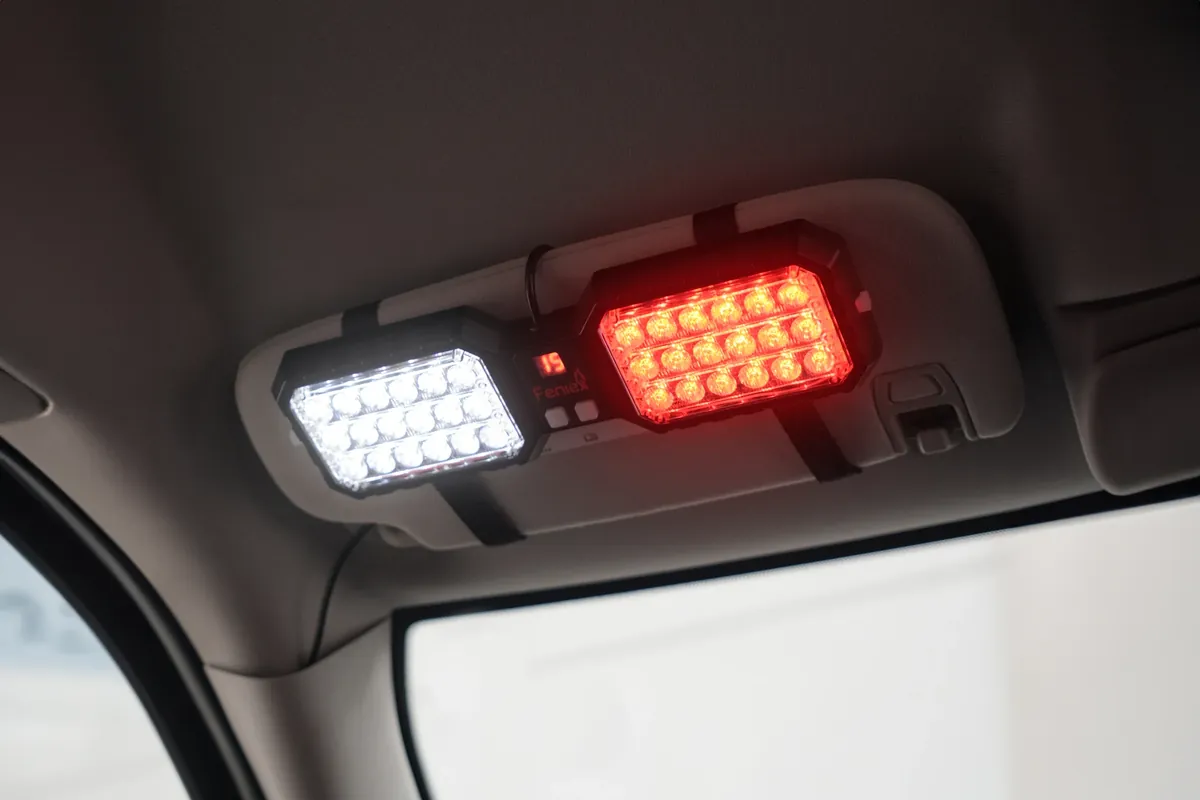
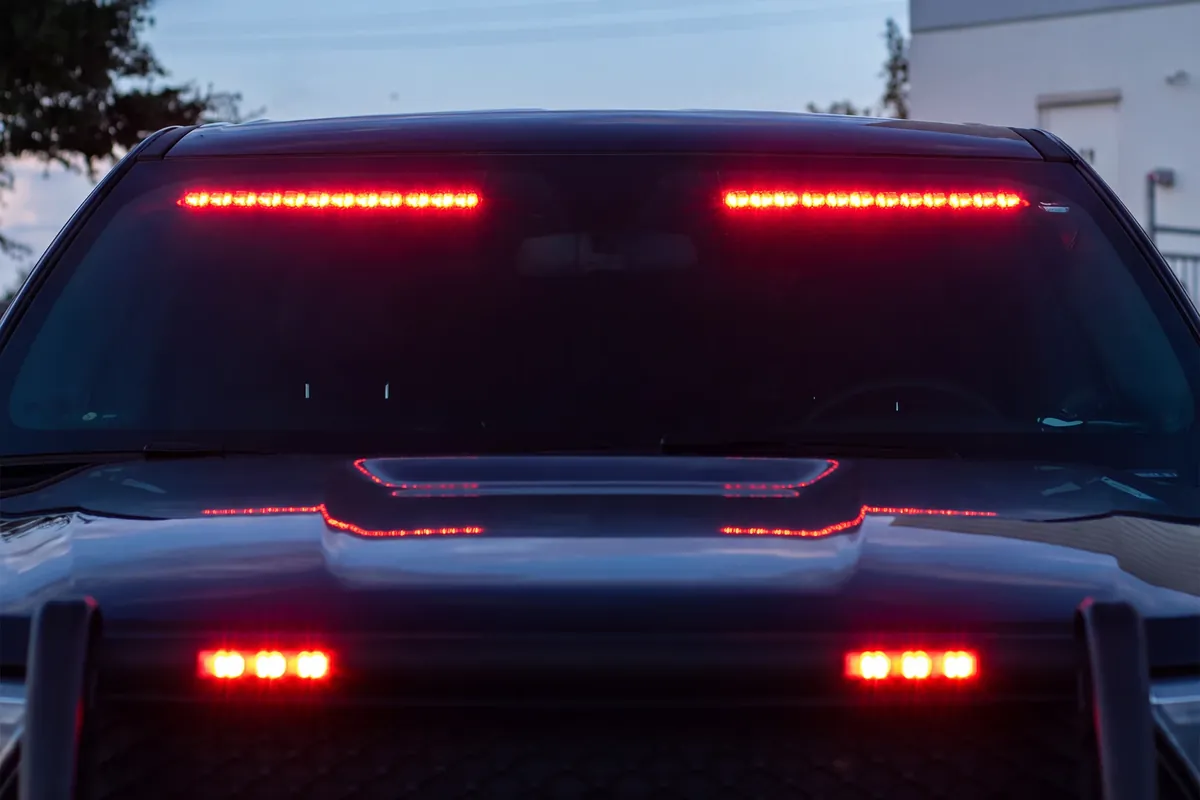
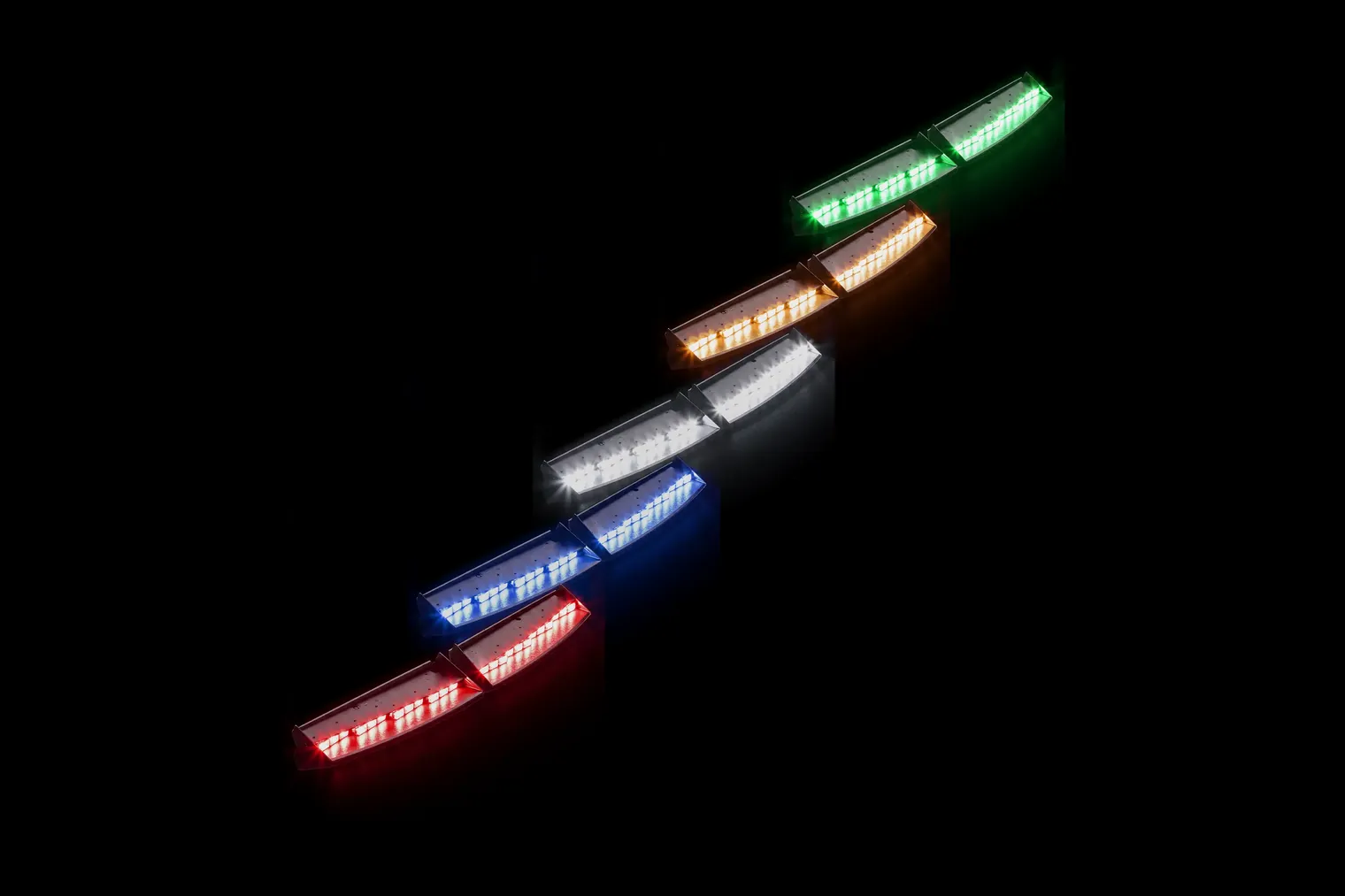
A dash light is the simplest start. The Fusion 2X mounts inside the windshield and is single-color, offered in red, blue, amber, white and green.
Find the right setup through a Feniex dealer
Use the dealer locator to find an authorized Feniex dealer or upfitter near you, or browse the Deck & Dash lights that come out of the vehicle when your shift ends.