Fire Truck Lights: Colors, NFPA 1900 Zones and What to Buy
 By
·
4 minute read
Fire truck warning lights are mostly red, usually mixed with white, and sometimes amber, blue or green. NFPA 1900, the national standard for fire apparatus, divides the truck into zones and requires two modes: one for calling for the right-of-way on the way to a call, and one for when the truck is stopped and blocking the road. White is allowed while responding but not while blocking, and green is now allowed in every zone but doesn't count toward the required light. State law decides the rest.
Below are the NFPA 1900 rules in plain terms, where the lights go, why some trucks run green or blue, and what to buy.
NFPA 1900 sets two warning modes
NFPA 1900 replaced the older NFPA 1901 apparatus standard, and its 2024 edition requires the warning system to signal at least two ways:
Calling for the right-of-way
The truck is moving to a call. Light is weighted to the front, so drivers ahead see it coming.
Blocking the right-of-way
The truck is stopped at the scene. Light shifts to the rear, where traffic is coming up on the crew.
The minimums show the shift. On large apparatus, the upper front zone needs 1,000,000 candela-seconds per minute while responding but only 400,000 while blocking, and the upper rear zone goes the other way, from 400,000 to 800,000.
Which colors NFPA 1900 allows where
The standard names the front of the truck Zone A, the rear Zone C, and the sides B and D. Its color table:
| Color | Calling for the right-of-way | Blocking the right-of-way |
|---|---|---|
| Red | Any zone | Any zone |
| Blue | Any zone | Any zone |
| Yellow | Any zone except the front | Any zone |
| White | Any zone except the rear | Not permitted |
| Green | Any zone, not counted toward the minimums | Any zone, not counted toward the minimums |
NFPA 1900 (2024), Table 10.7.13.1, as reprinted in the same report. A proposal for the 2027 edition would allow amber in the front zone without counting toward its output; that wording is not final.
The practical rule: if the front of the truck runs white while responding, set the blocking mode so the white goes dark when the truck parks. Lights that carry several colors in each module let you change that in programming instead of hardware.
Upper and lower lights, and where they go
NFPA 1900 also sets heights. It counts a truck as "large apparatus" if it is 25 feet or longer, or has any warning light centered more than 8 feet 6 inches up. Lower-level lights sit 18 to 62 inches above the ground on large apparatus and 18 to 48 inches on small ones, and a large truck needs midship lights if its front and rear lower lights are more than 25 feet apart. On small apparatus, the upper lights have to be seen all the way around.
One more rule: a single failed light can't leave a zone without a visible warning at 100 feet, so plan at least two lights for every zone.
The Fire Apparatus Manufacturers' Association's buyer's guide, written in 2018 for NFPA 1901, describes the usual layout:
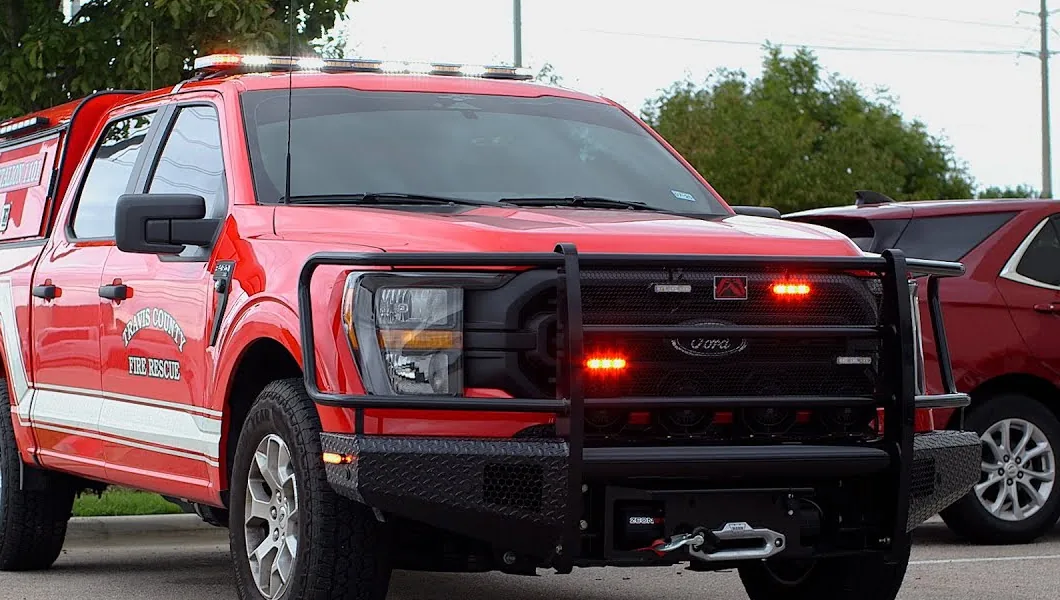
Upper front
A lightbar on the cab roof.
Lower front
Two to four perimeter or directional lights in the grille and bumper.
Sides
Perimeter lights, the same package on the left and the right.
Upper rear
Beacons, mini lightbars or perimeter lights.
Why some fire trucks have green or blue lights
Green. NFPA 1900 now permits green in every zone. Some states give it a job: in Wisconsin, a fire department vehicle serving as the command post at a scene may show a blue or green light, and Washington lets firefighters approved by their chief use a green light to identify themselves. No federal rule makes green mean "command post"; it is state law and local practice.
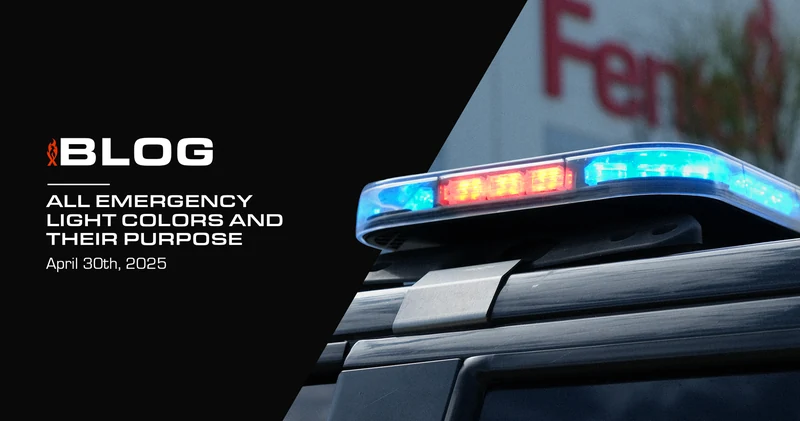
Blue. Several states let fire vehicles add blue, usually facing backward. Washington allows rear-facing blue on fire department vehicles, Louisiana allows blue on the rear, and New York allows blue on fire vehicles for rear projection only. Delaware lets volunteer fire company vehicles flash blue and red. For every color and who may use it, see our guide to emergency light colors.
Turn it down at night
Bright warning lights that work at noon can blind drivers at midnight. NFPA 1900 doesn't require a night mode, but its 2024 edition added guidance for departments that want one, as Fire Apparatus Magazine reported. The research points the same way: a 2008 study funded by the U.S. Fire Administration concluded that the biggest gains may come from different light levels for night and day, and the U.S. Fire Administration notes that lower intensity at night keeps the warning while letting drivers see the responders. It also rates blue and white as the most glaring colors.
What to put on a fire truck
- A roof lightbar for the upper front. The Quantum® 49” carries red, blue, amber, white and green in every module, so one bar can be programmed for both modes. The Fusion-S 49” uses single-color modules you lay out yourself.
- Perimeter lights for the grille, bumper and sides. The Q Series Surface Mount has all five colors in every module, so the same light works in any zone.
- An arrow for traffic at the rear. The Quantum® Arrow adds a directional arrow to move traffic away from the scene.
- Scene lights for the work. Warning lights don't light the scene. The Perimeter Flood Light puts out 4,500 raw lumens in scene mode and 1,800 in reverse mode.
Planning the budget? See what it costs to upfit a fire truck. Volunteers lighting a personal vehicle should start with what each state allows.