Police Siren Sounds Explained: Wail, Yelp and Hi-Lo
 By
·
6 minute read
A police siren sounds like one of two standard tones, the only two a siren must have to meet the SAE standard. The wail is a slow rise and fall in pitch that repeats every 2 to 6 seconds. The yelp is the same sweep sped up to 150 to 250 cycles a minute. Most sirens add more: a two-note hi-lo, a very fast phaser and an electronic air horn, and responders switch between them as they drive.
Here is what each tone sounds like, when responders use it, and how loud a siren has to be.
| Tone | What it sounds like | How fast | When responders use it |
|---|---|---|---|
| Wail | A slow rise and fall, built to imitate the old mechanical siren | 10–30 cycles a minute | Open road, until the vehicle nears an intersection |
| Yelp | The same sweep, much faster | 150–250 cycles a minute | Intersections, heavy traffic and lane changes |
| Hi-lo | Two fixed notes, alternating | 35–80 cycles a minute | Special situations; in California, evacuation notices only |
| Phaser | An even faster sweep | About 800–1,300 cycles a minute, depending on the maker | Short bursts to get attention at intersections |
| Air horn | A simulated air horn: a deep note with overtones | Bursts of 1–2 seconds | Short blasts approaching an intersection |
| Manual | Pitch climbs while the button is held and falls when it is released | Set by the driver | Short, hand-controlled warnings |
Wail and yelp rates are the ranges in SAE J1849 (2012 edition, as summarized by the Federal Railroad Administration), and California's siren rules set the same ones. Hi-lo is from California's hi-lo rules; phaser from siren makers' manuals; air horn from the same federal report.
The wail is the police siren sound most people picture
The wail was designed to mimic a mechanical siren, the motor-driven kind that winds up and down, according to the Justice Department's 2000 guide to emergency vehicle sirens. Under the SAE standard, each wail cycle lasts 2 to 6 seconds and sweeps at least 850 Hz somewhere between 650 and 2,000 Hz. Makers pick a rate inside that band: the manuals of four siren makers we checked run from 11 to 15 cycles a minute.
It is the tone for open road. The federal driving course in the next section keeps the siren in wail until the vehicle is about 300 feet from an intersection.
The yelp is the same sweep, several times a second
The yelp runs the same rising and falling sweep at 150 to 250 cycles a minute, roughly 2.5 to 4 times a second. NHTSA's 1995 emergency vehicle operator course for ambulance crews teaches a set routine at intersections:
- Run the siren in wail until about 300 feet before the intersection.
- Switch to yelp at 150 feet.
- Give two short blasts on the air horn, if the vehicle has one.
- Stay in yelp through the intersection.
The same course puts the siren in yelp for lane changes on the highway, because it helps other drivers pick out the vehicle. The switching is built into the hardware: the federal ambulance specification requires that, with the siren on, the vehicle's horn button change the siren tone, so the driver can switch without letting go of the wheel.
Hi-lo is the two-note sound, and in California it means evacuate
Hi-lo alternates between two fixed pitches. It is the sound associated with European emergency vehicles; California even names one of its approved note pairs "European." The Justice Department's guide notes that the SAE standard (1995 edition) treated hi-lo and the other extra tones as auxiliary sounds for non-emergency use, not as a call for the right of way. Omaha's fire department, for one, does not recommend it in its response guideline.
California goes further. Since 2020, state law says a hi-lo warning sound may be used only to tell the public about an immediate evacuation, and "is not a siren." The state's rules fix three approved note pairs, including a "USA" pair of 932 and 740 Hz.
Phaser and air horn are short bursts for intersections
A phaser is an extremely fast sweep. Siren makers give it different names and run it at anywhere from about 800 to 1,300 cycles a minute. It is meant to grab attention in short bursts, mostly at intersections, rather than to be the main tone. California is strict here too: its siren rules allow only wail, yelp and manual functions, plus voice, on sirens sold since 1982.
The air horn tone is a simulated air horn: a deep 65 Hz note with overtones stacked above it, played in bursts of a second or two. Omaha's guideline also suggests a tap of the air horn, with the siren off, when traffic ahead cannot move.
How loud is a police siren? About 120 decibels at 10 feet
Siren standards measure loudness about 10 feet in front of the speaker:
- SAE J1849 (2012 edition) calls for at least 118 dB(A) at the top of the sweep and 111 dB(A) at the bottom.
- California's loudest siren class must reach 120 dB(A) at 3 meters (9.8 feet).
- The federal ambulance specification requires 123 dB(A) at 10 feet.
Sound falls about 6 decibels each time the distance doubles, so a siren that measures 118 dB(A) at 10 feet is around 98 dB(A) at 100 feet. State laws set the bar in distance instead: Texas and Kentucky require sirens audible at 500 feet, and North Carolina's yield law refers to a siren audible at 1,000 feet.
That volume is hard on the crew. The SAE standard has recommended keeping the level in the cab at or below 85 dB(A) with the siren running, to limit hearing damage. In testing reported in the Justice Department's guide, moving the speaker from the cab roof to the grille cut the level in the cab by 16 to 22 dB.
Drivers still miss sirens, which is why responders keep changing tones
Modern cars are quiet inside, and that works against the siren. The Justice Department's guide puts it plainly: sirens "do not produce sounds that are loud enough to warn effectively in all circumstances." NHTSA's operator course gives an example: at 55 mph with the windows up and the radio on, a driver may not notice a wailing siren until it is as close as 33 feet. Drivers on a cross street get only about a third of the warning that drivers ahead of the vehicle get.
So the course tells responders to change tones often in city traffic, where a single tone gets lost in the noise, and to use a different tone from the vehicle ahead when several units respond together. The U.S. Fire Administration adds that with soundproofed cars and drivers distracted by their phones, sirens are "often useless." Warning lights carry the rest of the load, and our post on why police lights are red and blue covers how their colors work.
Low-frequency sirens are felt as well as heard, but the evidence is mixed
A low-frequency siren adds a second amplifier and speaker that play the main siren's tone at a much lower pitch, so other drivers feel it through the car as well as hear it. It runs in short, timed bursts, usually approaching an intersection. The fire apparatus makers' association notes that the SAE siren standard does not recognize these units; they are added to a main siren, not used in place of one.
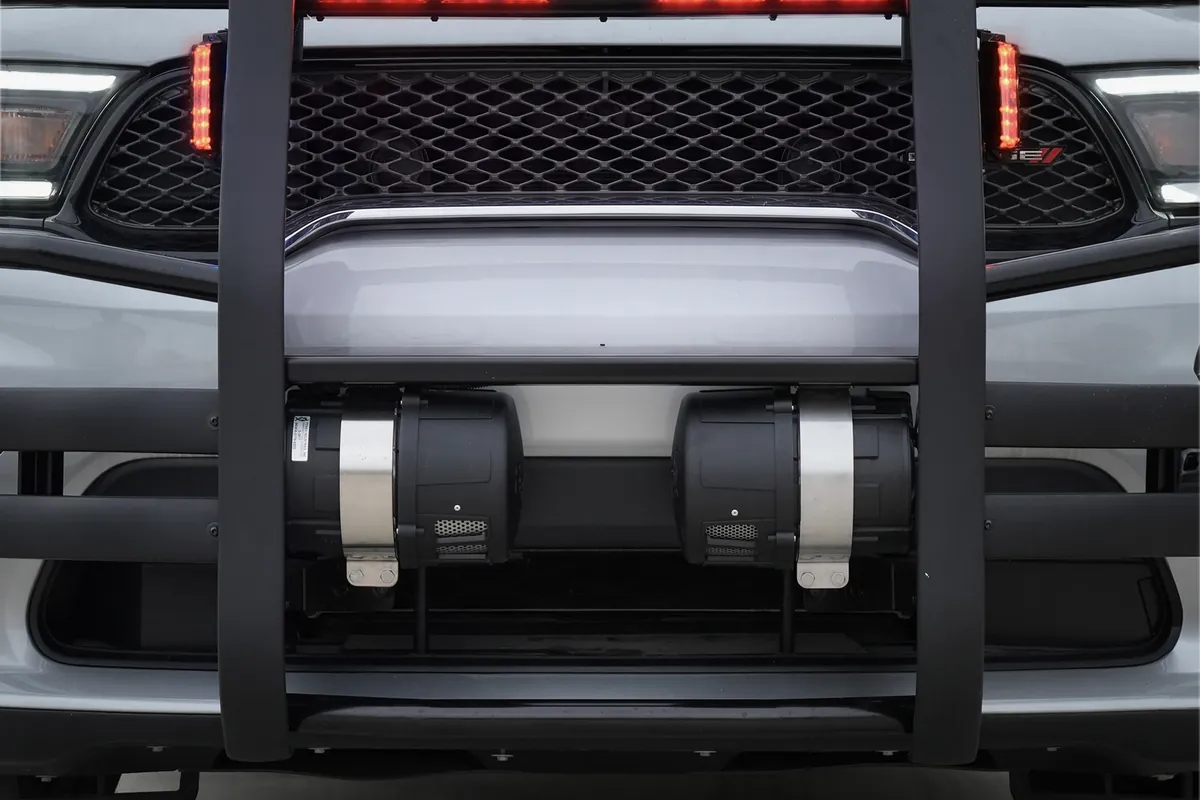
The research points both ways. A 2013 modeling study found that extending wail and yelp to lower frequencies could add about 40% to the distance at which drivers in cars detect them. A 2007 study of 240 ambulance runs found that adding high-frequency sound, the opposite approach, improved how well the siren got into cars and how well drivers located it. Fire and Rescue NSW's commissioner told ABC News in 2015 that trials in central Sydney cut about 30 seconds from a five-minute response, but we found no published data behind the figure.
A siren system is an amplifier and a speaker, tested together
An electronic siren, the kind on most police cars, has two halves: an amplifier that generates the tones and a speaker that projects them. Approvals treat them as one system. California's rules and the federal ambulance specification approve siren systems, not separate parts, and the fire apparatus makers' guide warns that swapping one component can take a system out of SAE J1849 compliance. If your spec calls for J1849, ask for certification that covers the amplifier and speaker together.
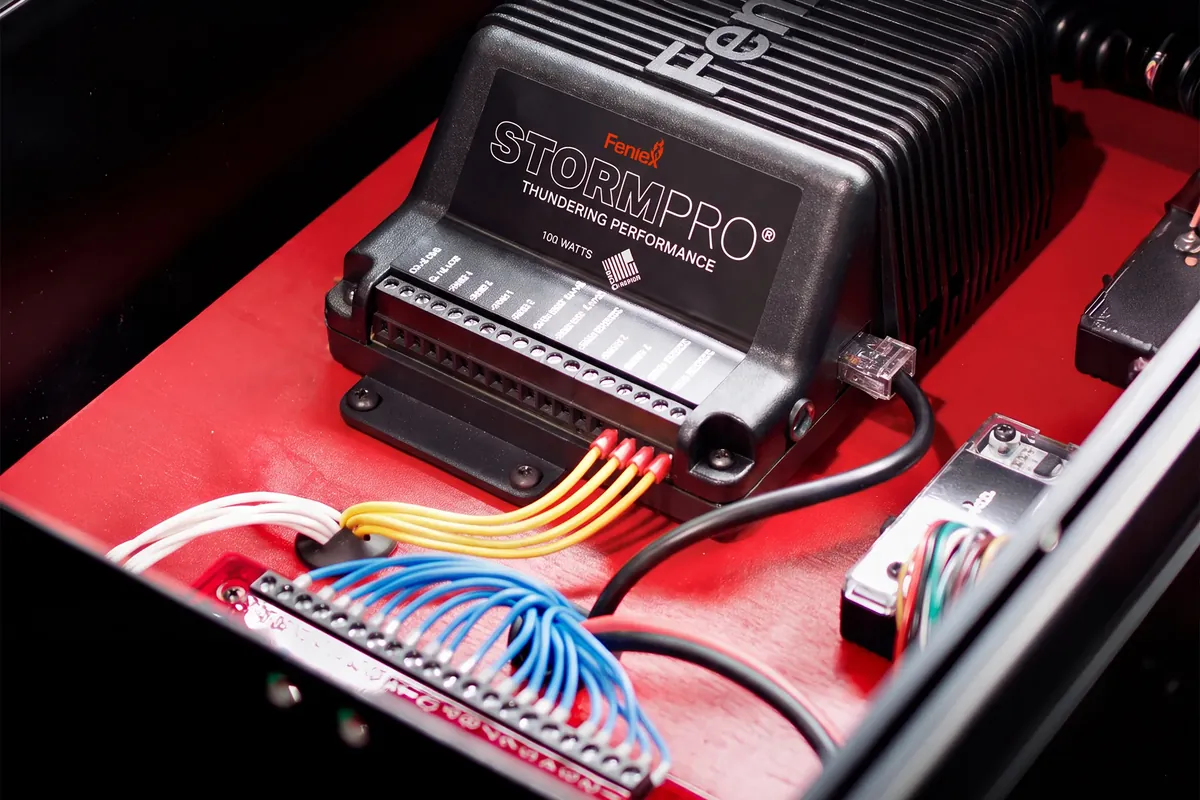
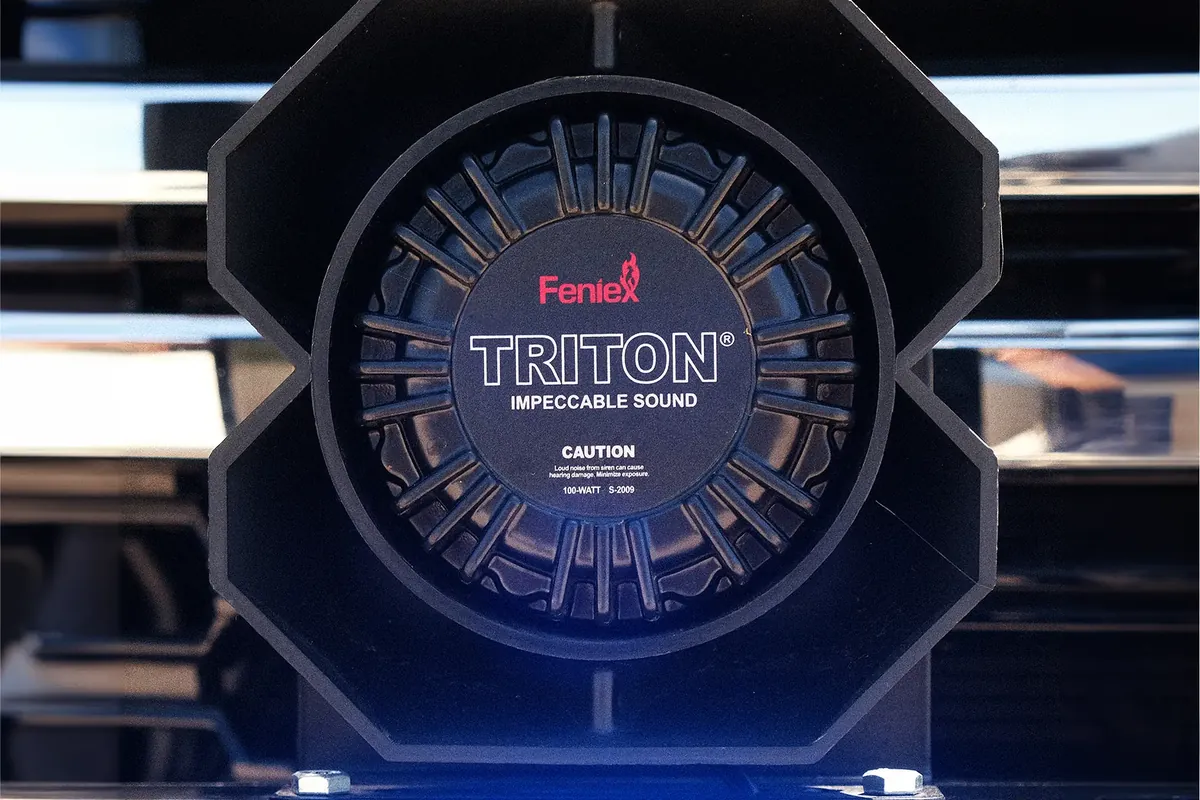
On a SynQ® controller, a 200-watt dual-tone siren runs from the same button panel as the lights. Whether a volunteer's own vehicle may carry a siren at all depends on the state; our state-by-state guide to volunteer firefighter lights covers it. Siren rules differ by state, and California approves siren systems under its own rules, so confirm what is allowed where the vehicle will run. To match a siren to your vehicle, find an authorized Feniex dealer or upfitter. Outfitting the whole vehicle? See what an emergency vehicle upfit includes and costs.