Emergency Light and Siren Controllers: How They Work
 By
·
4 minute read
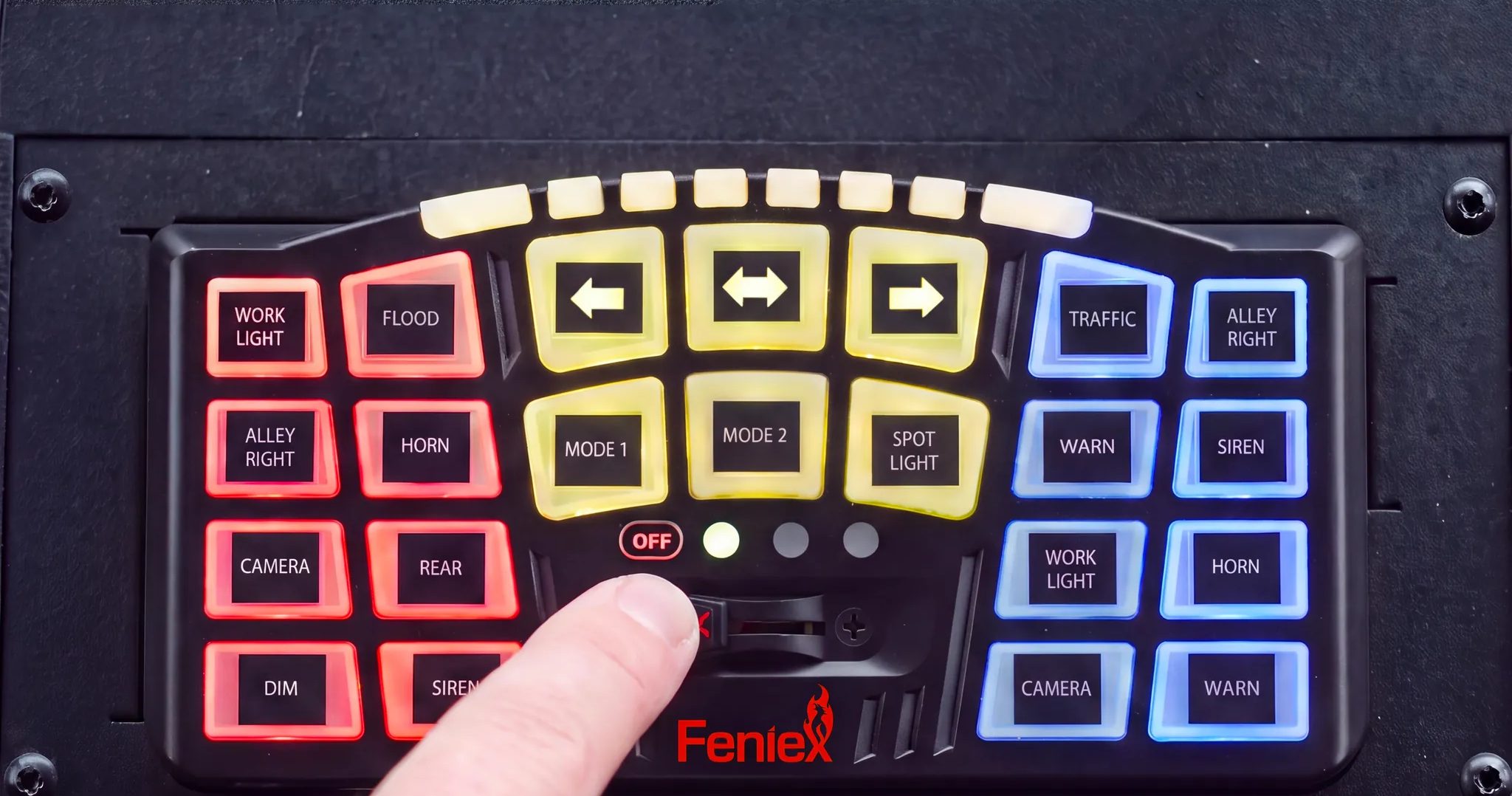
An emergency light and siren controller is the switch panel that runs every warning light and siren tone on a police car, fire truck or ambulance from the driver's seat. It takes power from the battery through a relay box, sends it to each light in the pattern you pick, and plays siren tones through an amplifier and speaker. One button can change the whole vehicle from responding to blocking a lane.
Here is what the parts do, how a controller is wired, and how to pick one for your vehicle.
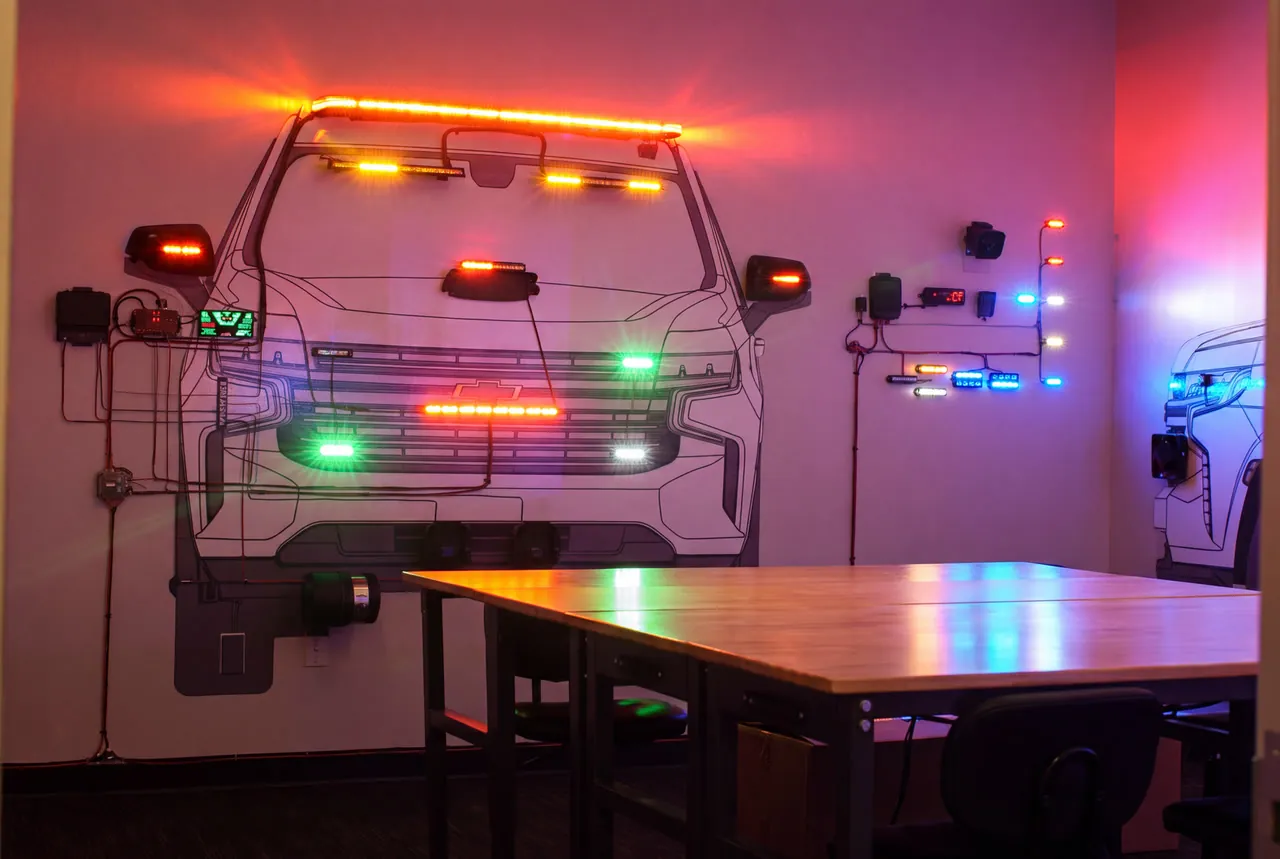
A controller is one switch panel for every light and tone
Every system, from a six-button box to a full patrol setup, has the same four parts.
Control head
The buttons, knob or handheld unit the driver touches. It sends commands; it does not carry the lights' power.
Relay box
Mounted out of sight, it switches battery power to each light circuit and holds the programming.
Siren amplifier
Generates the tones, the horn and the PA. In many systems it is built into the relay box.
Speaker
Turns the amplifier's signal into sound, usually behind the grille or on the push bumper.
The Feniex SynQ® platform splits it this way. Three control heads share one SynQ Relay with a built-in 200W dual-tone siren: the SynQ-S with 22 buttons and a slide switch, the SynQ-R with a rotary knob, and the SynQ-H, a handheld with a built-in PA microphone. The SynQ-S cut sheet lists more than 15 programmable siren tones and more than 20 audio commands.
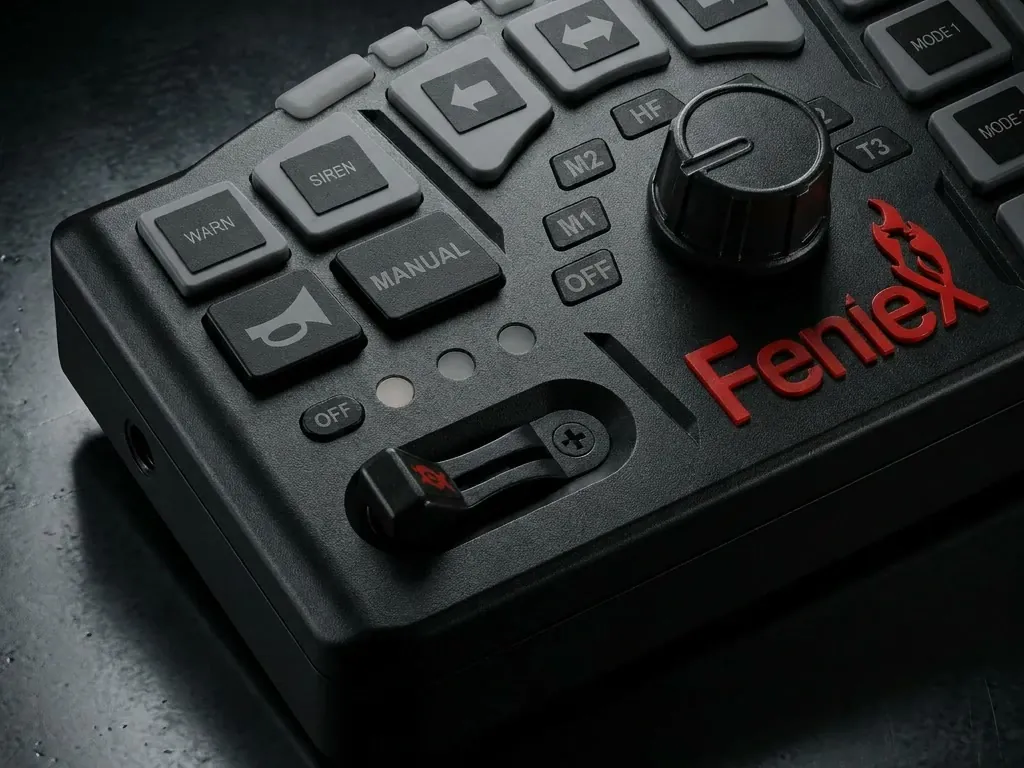
The controller switches modes, not single lights
Officers don't flip 20 lights one at a time. The controller groups outputs into modes, and a single button or slide-switch position turns on the whole mode: a full warning pattern for responding, a traffic advisor arrow for blocking a lane, white takedown lights for a traffic stop.
- Buttons can behave differently. On SynQ, each one can be set as on/off, momentary, multi-touch or timer, according to the SynQ manual.
- Priority settles conflicts. When two modes want the same light, the higher-priority mode wins; with equal priority, the last button pressed takes over.
- Siren tones are their own buttons. SynQ's tone list starts with wail, yelp, fast yelp, phaser, horn, mechanical, manual wail and hi-lo. Our guide to police siren sounds explains when each one is used.
- Voice commands come through the speaker. SynQ's recorded commands, in English and Spanish, include "Pull over" and "Clear the way."
Inputs let the vehicle run the controller for you
Inputs are wires from the vehicle that trigger the controller without a button press. The common ones:
Horn ring and hands-free
The steering-wheel horn changes siren tones, so the driver's hands stay on the wheel. On SynQ, the hands-free input lets the factory horn control the tones when it is enabled.
Park kill
The Typhoon manual defines it: park-kill "is used to deactivate any activated standard siren tone." Wire it to the park signal, a door trigger or the overhead light.
Radio rebroadcast
Plays the two-way radio through the siren speaker, so an officer outside the car can hear dispatch.
Taking over the factory horn needs one more part: SynQ's manual calls for a standard inline 5-pin relay to interrupt the factory horn circuit. For more vehicle signals, the SynQ catalog lists a CAN module that reads more than 40 triggers from the vehicle's own network.
How to wire emergency lights to a controller
Follow your controller's manual first; these steps come from Feniex's. The short version: battery to fuse to relay box, relay box to each light, a ground straight to the battery, and an ignition-switched trigger so nothing drains the battery overnight.
-
1. Ground to the battery
The SynQ manual says the ground wire "must be connected directly to the Negative (-) battery post," not to a body bolt.
-
2. Fuse the power feed
Install a fuse rated at 125% of the system's load at the battery end of the red wire. SynQ's manual rules out a circuit breaker or fusible link.
-
3. Size the wire
Heavier current needs thicker wire. Feniex's 20X manual calls for 6-gauge stranded wire, up to 20 feet, for 60 amps. On SynQ, all four power wires must be connected.
-
4. Switch it with the ignition
An inline ignition-switched relay between the battery and the controller keeps it from drawing power with the vehicle off.
-
5. Run outputs, speaker and inputs
Each light goes to its own output, the speaker to the speaker terminals, and the vehicle signals to the input wires.
-
6. Program and save
SynQ programs over USB-C from a computer. Its manual warns there is no autosave, so save the configuration often.
Every Feniex manual is on the instruction manuals page, and Feniex University has free wiring classes for Quantum® and Q Series lights.
Pick the controller by the size of the job
A volunteer's pickup with three lights does not need what a patrol SUV needs. Feniex's range, from the product pages:
| Controller | What it runs | Siren | Fits |
|---|---|---|---|
| SynQ® (S, R or H) | Every light on the vehicle, programmed by computer; works directly with Quantum® and Q Series serial lights | Built-in 200W dual-tone | Full patrol and fire builds |
| 4200 DL | 18 programmable 10-amp outputs, two inputs, a slide switch | Add a siren amplifier | Mid-size builds that need many circuits |
| Typhoon Handheld | Six light outputs from a handheld remote with a headlight flasher | 100W or 200W, with PA | One unit for lights and siren |
| 20X Controller | Solid-state outputs, set up without software | Add a siren amplifier | Simple builds without a laptop |
| 4200 Mini | Six programmable buttons with the relay built in, 20 amps total | None | Volunteer, tow and work trucks |
| Storm Pro 200W | A siren amplifier only: 23 tones, PA microphone | 200W, 130 dB | Adding a siren to a light controller |
Every siren needs a speaker matched to its wattage, such as the 100W Triton.
Where controller installs go wrong
A ground on a body bolt
Flickering lights and siren noise often trace back to the ground. Feniex's manual wants it on the negative battery post.
A dead battery after a shift
A controller wired to constant power keeps drawing with the key off. The ignition-switched relay in step 4 prevents it.
A lost configuration
Patterns built in the software and never saved are gone when the laptop closes. Save, then program the relay.
Building out a vehicle from scratch? Our guide to emergency vehicle upfitting covers the lights, power and cost around the controller.