Plow Truck Lights: An Amber Warning Light Buyer's Guide
 By
·
5 minute read
By
·
5 minute read
Plow truck lights are amber warning lights, mounted high and spread around the truck so other drivers can see it from every side, even with a blade out front and a spreader behind. Plan on a light bar or beacons on the cab plus flashing lights on the rear. Every state transportation department runs amber on its plows, but your state decides whether a private plow may, and some want a permit or a designation first.
Here is what to buy, where to mount it, and what the rules say.
Amber is the plow color, but your state decides who may run it
A 2020 Michigan DOT research report that surveyed state DOTs found every one uses amber on its winter maintenance trucks, and most add a second color: blue, red, white or green. Amber and yellow are the same signal color; the SAE color standard calls it "yellow amber."
Private plows are where the rules split. Eight snow states show the range:
| State | Private plows | What the law adds |
|---|---|---|
| Minnesota | Allowed, lit only while plowing or at a disabled vehicle | The lamp must be a type the Commissioner of Public Safety approves |
| Michigan | Required on plows paid to clear snow | At least one amber light visible 360° from 500 feet |
| New York | Allowed as "hazard vehicles," and must be lit while working | Mounted higher than the headlamps |
| Pennsylvania | Allowed, lit only while plowing | A single 360° light must meet SAE J845; 60 to 260 flashes a minute |
| Ohio | Not clearly covered | Listed work vehicles must show amber while working |
| Wisconsin | Not clearly covered, but trucks over 26,000 lb may run a 360° amber beacon | That beacon may be lit only when the truck is slow, stopped or backing on a road posted over 35 mph |
| Colorado | Only if designated an authorized service vehicle | Yellow only, visible 500 feet in sunlight |
| Massachusetts | Allowed if the truck shows the owner's name and is working; otherwise a Registrar permit | Other colors need a permit too |
State codes as of September 2026. For the other 42 states, see our 50-state guide to warning lights on private vehicles, and confirm with your state before you buy.
Check the cut sheet for the SAE standard and class
Two SAE standards cover warning lights. J845 covers lights that shine 360° or over a wide arc, like beacons; J595 covers directional flashing heads. Both sort lights into classes. In the 1997 edition of J845, the one federal truck rules cite:
- Class 1 is for emergency vehicles and needs about four times the output of Class 2.
- Class 2 is for maintenance and service vehicles warning of a hazard, such as a plow.
- Class 3 is for identification only.
A higher class may stand in for a lower one. For commercial trucks of 10,001 pounds or more in interstate commerce, federal rules require amber warning lamps to meet J845 and amber flashing lamps to meet J595. One thing J845 doesn't set is a distance: claims like "visible from 500 feet" come from state laws, not SAE.
So read the cut sheet for the standard and the class, not just "SAE." The Beacon AM600, for example, is rated SAE J595 Class 1.
Match the light to the truck
| Option | Where it goes | Feniex example | Current draw | Mounting |
|---|---|---|---|---|
| Full-size light bar | Cab roof or headache rack | Fusion-A Tow 49", all amber with white work lights | 14 A | Standard, adjustable, permanent or headache-rack mounts |
| Mini light bar | Cab roof | Quantum® Mini 27" | 9 A at 13 V | Magnet mount included; permanent optional |
| Beacon | Cab roof or rack; fleets often run a pair | Beacon AM600 | 2.5 A | Permanent standard; magnet or pole optional |
| Stick lights | Rear window, truck cap, rack | Quantum and Fusion sticks | 3–8 A | Window, L-bracket or headliner brackets |
| Perimeter heads | Grille, body sides, plow frame, spreader | Fusion surface mounts | About 1–2 A | L-bracket, rotating, hood or recessed |
Draw figures are from each product page, at 13 volts where the page says so. Every product listed is available in amber.
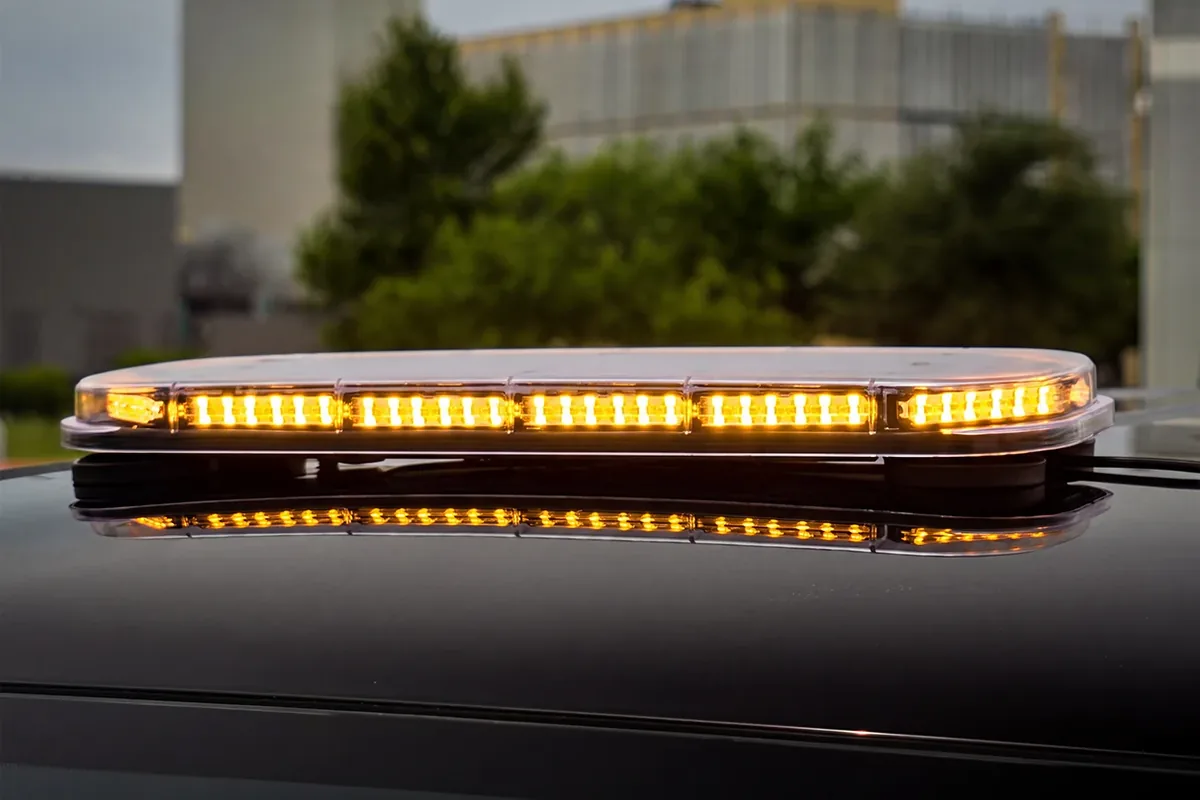
LEDs changed the power math. A 2011 Transportation Research Board paper puts filament beacons at about 50 to 60 watts, enough that crews idled their trucks for hours to protect the battery, and LED beacons at about 6 to 15 watts. LED products still vary: in a 2008 Minnesota DOT test, LED heads drew anywhere from 13 to 42 watts.
Magnet and plug-in mounts suit a truck that plows part-time. For a permanent install, the Missouri DOT fleet guide rules out magnets and suction cups, wants a switch with an indicator light in the cab, and says not to power lights from a cigarette lighter.
One roof light rarely covers 360° once a blade or spreader is in the way
The SAE standard asks for a clear view from 5° above to 5° below horizontal and notes that it may take several lights to cover 360°. On a plow truck, the blade, spreader, rack or truck cap blocks part of that view. Minnesota DOT's work-zone page shows a truck rejected because its roof beacon was blocked, and its rule for contractors' equipment calls for at least one light visible all the way around from 60 feet.
A roof light also loses contrast against a bright sky, so research for the National Cooperative Highway Research Program recommends flat-mount heads repeated on the front, sides and rear, outlining the truck and its blade. New York's DOT specs its large dump trucks this way:
Cab roof
Two amber LED beacons, or a light bar on a pickup. This is the 360° anchor.
Rear body
Two amber flashers mounted high, where drivers behind the truck look.
Hopper
In snow service, two more flashers on the edges of the hopper airfoil.
From the NYSDOT vehicle warning light standard (February 2025). On pickups with a cap, it requires the lights to sit high enough to show 360°.
More isn't always better. A 2025 AAA Foundation review found two to four lights alerted drivers better than fewer, while more than four could add glare, and lights mounted above drivers' eye height worked best.
LED lights run too cool to melt snow off their lenses
A halogen or strobe light throws off heat that helps keep its lens clear. An LED doesn't. A 2015 Clear Roads study of plow lighting says it plainly: "LEDs do not produce enough heat to melt snow and ice." The U.S. Department of Energy explains why: LEDs turn only 15% to 25% of their power into light, and the rest becomes heat that is conducted into the circuit board and heat sinks behind the LED.
In Minnesota DOT's 2008 test, an LED head built up a heavier coat of ice than a xenon strobe after about 30 minutes of heavy snow, and it could be seen from a shorter distance. What agencies do about it:
- Mount the lights as high as possible.
- Put rear lights behind an airfoil or wind deflector that keeps snow off.
- Add heated lenses on a cab switch. They draw extra current, and agencies report ice domes forming over heated lenses in cold storms around 15°F.
You'll also see claims that ice blocks 40% to 70% of an LED's light; we found that figure only on sellers' pages, with no study behind it.
Slower, alternating flash patterns tell drivers more
The 1997 SAE standard allows 1 to 4 flashes per second. The AAA Foundation review found that about one flash per second helps drivers judge whether a vehicle is moving, while faster flashing feels more urgent; left-right alternating patterns beat both sides flashing together, and double-flash and random patterns made it harder to judge distance. The highway research program's sample spec calls for at least two rear lights, alternating.
Brightness should change with the light, too. Lights bright enough for a sunny day cause glare at night, so the same research recommends separate day and night levels. The Beacon AM600 offers 20 flash patterns, each at a fast and slow speed, and syncs up to six units. The Fusion-A Tow bar's 21 patterns include a traffic advisor that directs drivers around the truck.
In a work zone, hazard flashers don't replace warning lights
The federal work-zone manual, the MUTCD, requires mobile operations to carry warning devices such as "high-intensity rotating, flashing, oscillating, or strobe lights," and it is blunt about the four-way flashers: they may supplement those lights, but "they shall not be used instead of these devices."
OSHA's construction rules adopt that part of the MUTCD. OSHA itself doesn't require amber beacons on trucks; its own vehicle rule covers headlights, taillights, brakes, horns and backup alarms. So when a site calls for warning lights, the requirement traces to the MUTCD and your state, not to an OSHA amber rule.
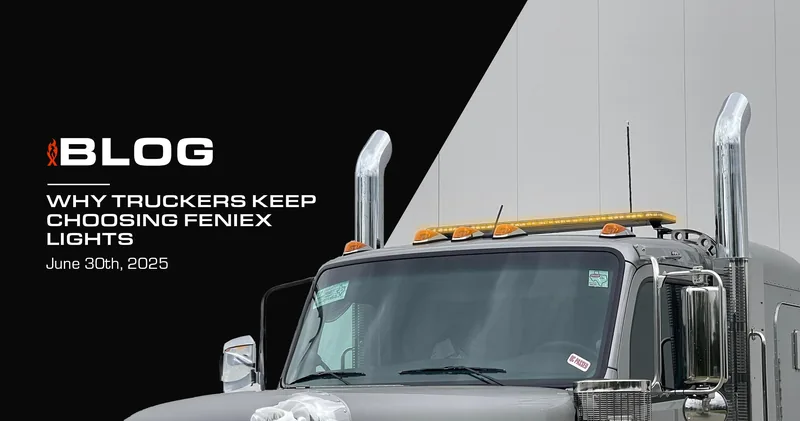
Hauling on the highway instead? Marker and stop-turn-tail lamps for semis are a different job; see why truckers choose Feniex lights. To spec a plow or work truck, find an authorized Feniex dealer.